
10/30/26
Think about how hard you work to save and invest your money. Whether it’s putting money away from every paycheck, building your retirement savings, or trying to make your money work for you, the goal is usually the same, see it grow. What about when the market takes a turn and some of that money disappears? To get back to where you started can take a lot more growth and it’s not talked about enough.
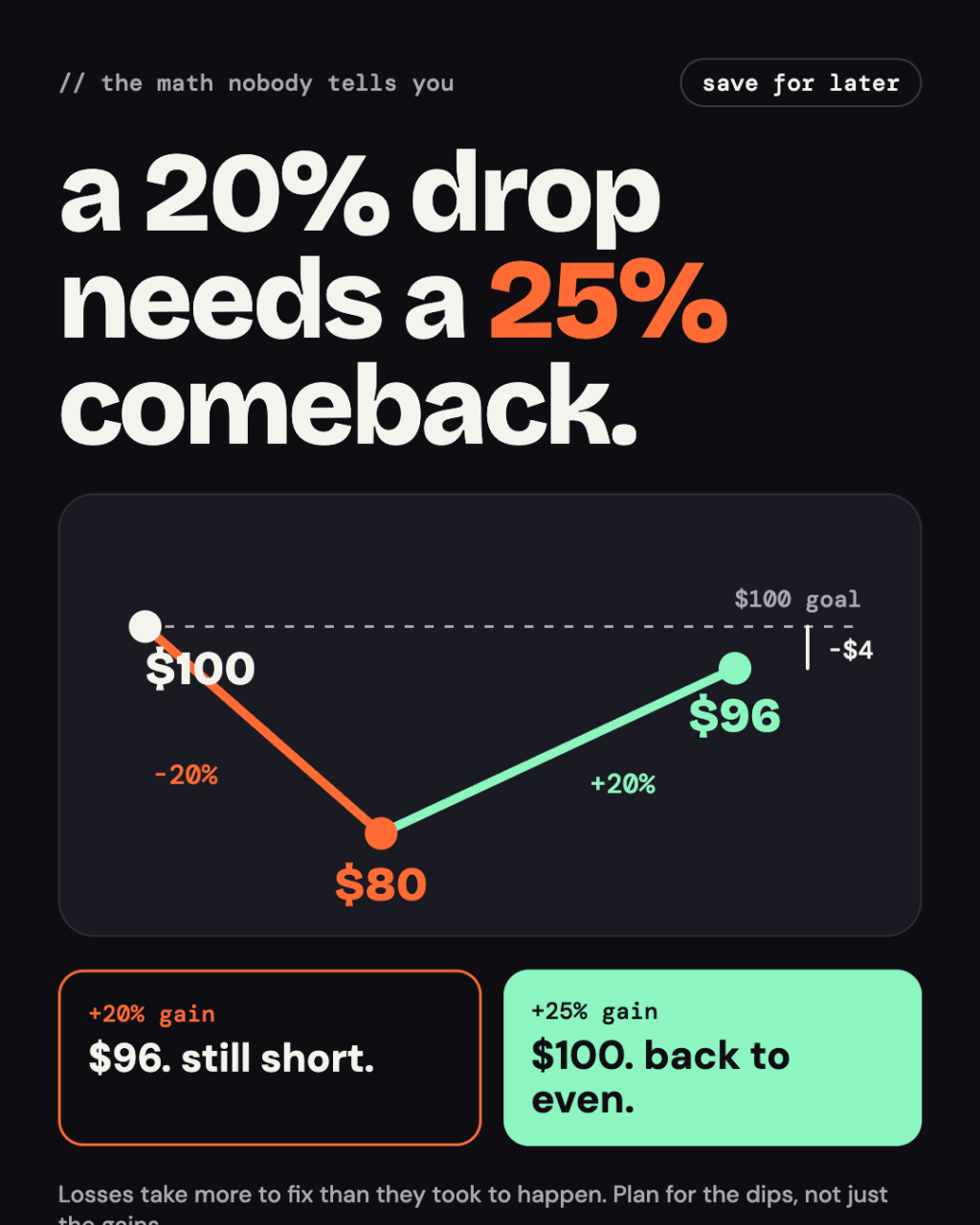
Say you have $100 invested. The market takes a downturn, and your investment loses 20% of its value. Your $100 is now worth $80.
You might think that if the market goes back up 20%, you’re right back where you started because on paper your average return shows 0%, AKA, you broke even. Unfortunately, that’s not fully correct. A 20% gain on $80 only brings you back to $96. To get your original $100 back, you actually need a 25% gain to break even.
Test out some numbers using this Break Even Calculator! This helps me run illustrations with potential/current clients.
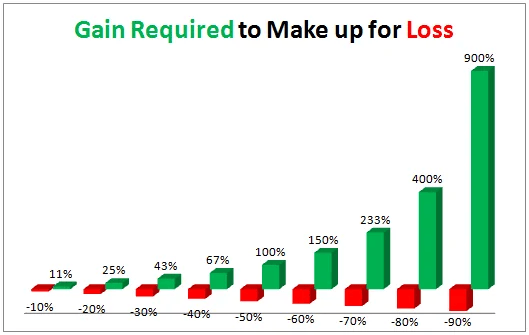
In regards to the importance of considering market loss and needed gain, I like to give the example of the infamous 2008 crash. During the 2008 financial crisis, the S&P 500 fell approximately 57% from its October 2007 peak to its March 2009 low. Now imagine, someone approaching retirement with $500,000 invested in an S&P 500 index fund. That account would have dropped to approximately $215,000, and to get back to the original $500,000, it would now need to grow by more than 132%!
The market didn’t recover overnight either. The S&P 500 didn’t return to its previous peak until March 2013, about 5 years and 5 months after its October 2007 high.
Think about someone who retired right before the crash. They could have spent years watching and waiting for the market to recover. Meanwhile, they still had bills to pay, groceries to buy, and everyday expenses to cover. If they needed to withdraw money during that downturn, they could have been selling investments at lower values, leaving less money available to participate in the eventual recovery. Many had to go back to work.
This is why I think it’s so important to look at both sides of investing. Growth matters, but so does understanding what happens when the market goes down and how to have more protection over at least a portion of your investments. The more time you allow compounding interest to work its magic, the last thing you have is worry.
So, when looking at your investments, don’t just ask how much you could potentially earn. Ask yourself what a market downturn could mean for your money and how much growth it would take to recover. Protecting what you’ve worked hard to build can be just as important as growing it.
Here’s something to consider… Have you ever sat down and figured out how much money you would actually need each year to retire comfortably? Think beyond just your monthly bills. Consider inflation and how the cost of living may change over time. Do you want to travel, enjoy new experiences, or maybe spoil your favorite grandchildren? Retirement should be about more than just making ends meet. Take some time to think about what you want your retirement to look like and whether your current savings strategy is helping you work toward that lifestyle. BTW, it’s never too early or late to have this conversation with yourself or a professional.


Leave a Reply